Physical Address
304 North Cardinal St.
Dorchester Center, MA 02124
Physical Address
304 North Cardinal St.
Dorchester Center, MA 02124

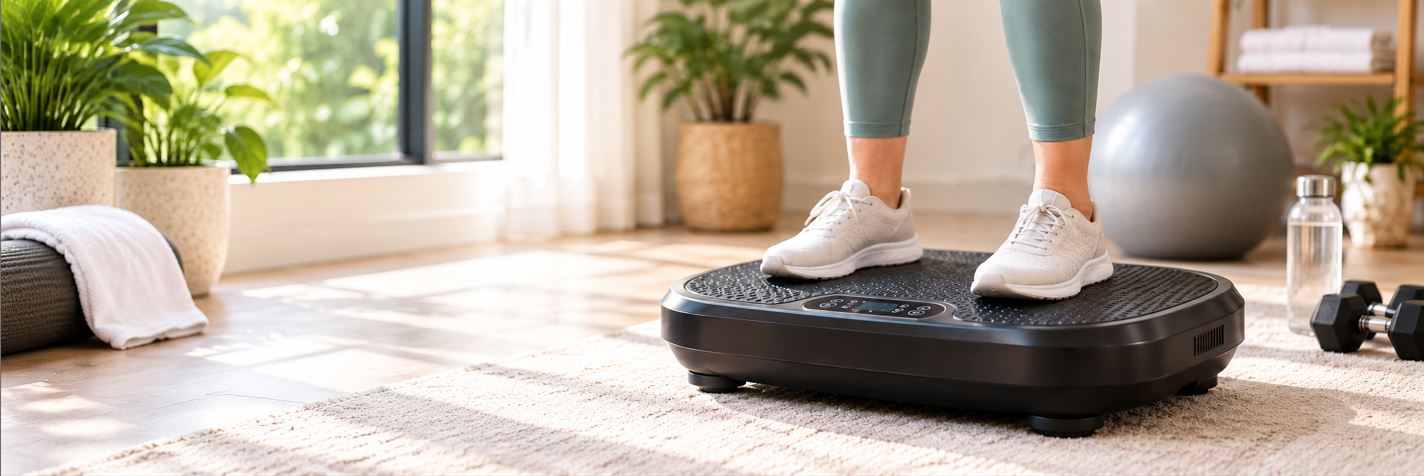
Do vibration plates burn calories? It’s a common question for anyone considering adding a vibration plate to their fitness routine.
The short answer is yes, but probably not as many as vibration plate advertisements sometimes suggest.
Vibration plates, also called whole-body vibration (WBV) platforms, cause rapid movements that require the muscles to make small, reflexive contractions to maintain balance. Those contractions require energy, which means the body does burn calories while using a vibration plate.
However, the calorie expenditure from simply standing on a vibration plate is relatively modest. The amount increases when the plate is combined with active exercises such as squats, lunges, or planks, but most of the additional calorie burn comes from the exercise itself rather than the vibration.
That makes vibration plates better viewed as a supplement to an active lifestyle rather than a replacement for walking, cardio, or strength training.
For anyone considering a vibration plate specifically for lymphatic support, it may also be useful to understand how vibration fits into a broader movement routine. See the guide to the Top 5 Vibration Plates for Lymphatic Drainage.
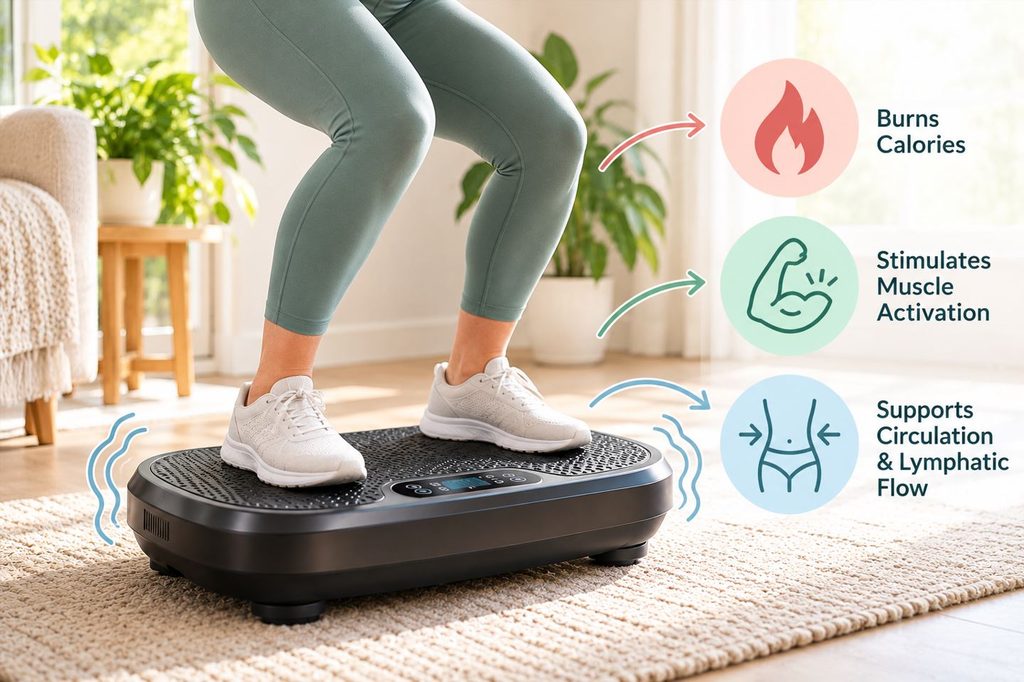
Whole-body vibration works by creating rapid oscillations beneath the body. Depending on the machine, the platform may move vertically, side to side, or in multiple directions.
When the platform moves, the body has to continually adjust to maintain balance.
The nervous system responds by activating muscles through rapid, involuntary contractions. These contractions require energy in the form of ATP, which means the body increases its oxygen consumption and energy expenditure.
Two important settings on a vibration plate are frequency and amplitude.
Frequency refers to how many vibrations occur per second and is measured in Hertz (Hz). Amplitude refers to the distance the platform moves during each vibration.
Higher frequencies and larger amplitudes can increase the mechanical demand placed on the body, although more intense settings aren’t necessarily better for everyone.
Beginners may find it more comfortable to start at a lower intensity and gradually increase the settings as they become accustomed to the sensation.
Standing on a vibration plate does involve muscular activity, but it shouldn’t be confused with a conventional cardio or strength-training workout.
Passive standing generally produces a much smaller energy expenditure than activities such as running, cycling, swimming, or resistance training.
Adding active movements can substantially increase the overall workout intensity.
A simple way to think about it is:
The vibration may add to the workload, but the exercise itself remains the primary driver of calorie expenditure.
The exact number of calories burned on a vibration plate varies considerably depending on body weight, vibration settings, exercise selection, and session length.
Research measuring oxygen consumption during whole-body vibration has found that passive vibration can increase energy expenditure compared with simply standing on a stable surface.
One commonly cited study found that participants burned approximately 27 calories during 15 minutes of low-intensity whole-body vibration, although individual results can vary.
At lower intensities, passive standing may burn roughly 1.8 to 2.3 calories per minute.
That would work out to approximately:
| Time | Estimated Calories |
|---|---|
| 5 minutes | 9–12 calories |
| 10 minutes | 18–23 calories |
| 15 minutes | 27–35 calories |
| 20 minutes | 36–46 calories |
| 30 minutes | 54–69 calories |
These numbers should be treated as estimates rather than exact calorie-burn measurements.
Calorie expenditure depends on several factors, including:
Someone performing squats on a vibration plate will burn considerably more calories than someone simply standing on it.
Yes.
Adding exercises to a vibration plate increases the overall energy expenditure because the muscles have to perform actual work in addition to responding to the vibration.
Exercises such as squats and lunges can significantly increase the intensity of a vibration plate workout.
The vibration may increase muscular activation and oxygen consumption, but most of the calories are still being burned because the body is performing the exercise.
Static exercises such as wall sits, planks, glute bridges, static lunges, and calf raises can also be performed on or around a vibration plate.
These exercises may be useful for people who want a low-impact way to incorporate additional muscular activity into their routine.
No.
A vibration plate can complement an exercise routine, but passive vibration isn’t a substitute for cardiovascular exercise.
Activities such as brisk walking, running, cycling, swimming, and other forms of aerobic exercise place a different demand on the cardiovascular system.
Similarly, progressive resistance training remains important for building and maintaining muscle.
A more realistic way to think about a vibration plate is:
Exercise + vibration may provide a slightly greater stimulus than exercise alone.
It isn’t:
Standing on a vibration plate = replacing a workout.
Vibration plates may contribute to weight loss when they’re incorporated into a broader program that includes appropriate nutrition and regular physical activity.
However, simply standing on a vibration plate is unlikely to create enough additional calorie expenditure to produce substantial weight loss by itself.
Research on whole-body vibration and body composition has produced mixed results, although some studies and reviews suggest that WBV may contribute to modest reductions in fat mass when combined with diet and exercise.
The important distinction is that these results generally involve whole-body vibration as part of a larger intervention, rather than vibration being used as a standalone weight-loss method.
Weight loss ultimately requires an energy deficit over time.
Because passive vibration burns a relatively small number of calories, relying on a vibration plate alone is unlikely to create a substantial deficit.
A vibration plate can potentially contribute to daily activity, but it shouldn’t be viewed as a way to offset a consistently high calorie intake.
Vibration plates cannot specifically target belly fat.
The body determines where it stores and loses fat based on genetics, hormones, overall energy balance, and other factors. Performing a particular exercise on a vibration plate does not cause fat to be selectively removed from the abdomen.
Overall fat loss is more relevant than trying to target a specific body area.
Understanding what a vibration plate can and cannot do becomes easier when comparing it with conventional activities.
Passive vibration and slow walking can produce relatively modest calorie expenditure.
However, walking provides additional benefits related to cardiovascular fitness, mobility, balance, and general physical activity.
Running requires substantially more cardiovascular effort than passive vibration.
A vibration plate should not be considered an alternative to running if the goal is to improve running fitness or substantially increase cardiovascular endurance.
Resistance training provides a progressive stimulus that helps build and maintain muscle.
A vibration plate can be used alongside strength exercises, but vibration alone shouldn’t replace a structured resistance-training program when muscle development is the goal.
Rebounding is another low-impact movement option that has become popular among people interested in lymphatic wellness.
Unlike passive vibration, rebounding involves actively moving the body through space and can provide a cardiovascular workout depending on the intensity.
For anyone considering rebounding as another option, see the Best Rebounders for Lymphatic Drainage guide.
Vibration plates are frequently marketed for lymphatic drainage, circulation, and recovery.
There is research exploring vibration therapy and blood flow, muscle activation, and lymphatic-related applications, but the evidence varies depending on the specific condition, vibration protocol, and outcome being studied.
For that reason, vibration should be considered a potential complementary wellness tool, rather than a treatment for a medical condition.
Unlike the cardiovascular system, the lymphatic system does not have a central pump comparable to the heart.
Muscle contractions and physical movement play an important role in helping lymph fluid move through the body.
This is one reason regular movement is commonly included in approaches to supporting lymphatic health.
For more information about movement and lymphatic wellness, see Clogged Lymphatic System Symptoms: What It Feels Like.
Because whole-body vibration causes repeated muscle contractions, researchers have investigated whether it may influence circulation and fluid movement.
Some studies have found changes in blood flow during or following vibration exposure, while other research has explored vibration alongside treatments such as manual lymphatic drainage.
However, these findings don’t establish that a consumer vibration plate can treat lymphedema, lipedema, or another medical condition.
Anyone using vibration because of a diagnosed condition should discuss it with an appropriate healthcare professional.
A vibration plate may be appealing to people who want to add movement without relying exclusively on high-impact activities.
Vibration plates can provide an alternative way to engage the muscles without running or jumping.
That may make them appealing for people who prefer lower-impact exercise.
A vibration plate can add variety to a home workout routine and can be combined with exercises such as squats, lunges, calf raises, and planks.
Research has also investigated whole-body vibration for balance and neuromuscular function, particularly among older adults.
Because balance can be affected by age, inactivity, and other factors, vibration training may be useful in some exercise programs.
Vibration plates have become popular partly because of aggressive marketing claims.
Some advertisements suggest that vibration can replicate hours of exercise, dramatically increase calorie expenditure, or “melt fat.”
Those claims need to be viewed carefully.
Vibration can cause rapid muscle contractions, but the number of contractions does not directly translate into the number of calories burned.
A small reflexive contraction is not equivalent to performing a heavy squat, running a mile, or completing a demanding resistance-training session.
The body’s energy expenditure depends on the intensity and type of muscular work being performed.
Counting contractions alone doesn’t tell you how effective a workout will be.
No.
Vibration doesn’t literally melt body fat.
Fat loss occurs when the body uses more energy than it takes in over time. Heat produced by normal muscle activity is not a mechanism that selectively melts stored body fat.
Passive standing on a vibration plate generally shouldn’t be treated as a cardiovascular workout.
Heart rate may increase more substantially when active exercises are performed on the platform, but that increase is largely related to the exercise itself.
For anyone who wants to incorporate a vibration plate into a fitness or wellness routine, active use may provide more value than simply standing on the platform.
Beginners can start with a lower vibration setting and shorter sessions.
Depending on the machine and fitness level, exercises can include:
More vibration isn’t necessarily better.
Longer or higher-intensity sessions may increase muscle soreness or discomfort, particularly for people who are new to whole-body vibration.
A vibration plate works best as part of a broader activity routine.
It can be combined with walking, strength training, cycling, swimming, mobility exercises, rebounding, and stretching.
For readers specifically interested in lymphatic wellness tools, Top 5 Lymphatic Drainage Massage Machines provides another look at equipment that can complement an at-home routine.
The biggest mistake is assuming that vibration dramatically increases calorie expenditure.
Even a 15–20% increase sounds substantial until it is applied to a relatively low baseline.
A vibration plate shouldn’t replace regular physical activity.
For overall fitness, a combination of aerobic movement and resistance training provides benefits that passive vibration cannot fully replicate.
Turning the vibration setting to its highest level doesn’t necessarily produce better results.
Vibration should not cause significant pain.
Headaches, excessive soreness, joint discomfort, dizziness, or other unusual symptoms are reasons to stop and reassess the activity.
Vibration plates are generally tolerated by many healthy adults when used according to the manufacturer’s instructions, but they aren’t appropriate for everyone.
People who are pregnant, have certain cardiovascular conditions, have a pacemaker or other implanted medical device, have certain musculoskeletal conditions, or have other significant medical concerns should consult a healthcare professional before using whole-body vibration.
People with diagnosed lymphedema, lipedema, significant swelling, or another medical condition should also discuss vibration therapy with their healthcare provider.
Passive standing on a vibration plate for 10 minutes may burn approximately 18–23 calories, although actual energy expenditure varies based on body weight, vibration settings, and individual factors.
Vibration plates cannot specifically target belly fat.
Whole-body vibration may contribute to modest changes in body composition when combined with appropriate nutrition and regular physical activity, but it isn’t a standalone method for reducing abdominal fat.
Ten minutes of passive standing provides only a relatively small amount of exercise stimulus.
However, 10 minutes of active exercises on a vibration plate can be a useful addition to a broader fitness routine.
Standing on a vibration plate does increase muscular activity and energy expenditure compared with standing still.
However, the increase is relatively small.
There isn’t a specific amount of vibration-plate use that guarantees weight loss.
If weight loss is the goal, nutrition, overall physical activity, resistance training, cardiovascular exercise, sleep, and consistency all matter.
Whole-body vibration has been studied for balance, muscle function, and physical performance in older adults.
It may be an option for some seniors who want a low-impact form of exercise, but individual suitability varies.
Vibration can temporarily increase blood flow in certain circumstances, and researchers have investigated its effects on circulation and vascular function.
However, vibration should not be considered a replacement for regular aerobic activity when the goal is improving overall cardiovascular health.
Vibration therapy is being studied for its potential effects on circulation, muscle activity, and lymphatic-related outcomes.
Some research has explored vibration alongside other lymphatic therapies, but evidence is still developing.
A vibration plate should be viewed as a complementary wellness tool rather than a treatment for lymphedema, lipedema, or another medical condition.
Yes, vibration plates burn calories—but the amount is relatively modest when you’re simply standing on one.
Whole-body vibration causes muscles to make rapid contractions, which increases energy expenditure compared with standing on a stable surface. However, the calorie difference isn’t large enough to make passive vibration a replacement for walking, cardio, or strength training.
The biggest increase in calorie expenditure comes from actively exercising on the platform. Squats, lunges, planks, and other movements can turn a vibration plate into a more substantial workout, although much of the calorie burn comes from the exercises themselves.
For people interested in lymphatic wellness, vibration plates may also be worth considering as one component of a broader movement routine. Research into vibration and lymphatic-related applications is ongoing, so expectations should remain realistic.
Ultimately, a vibration plate is best viewed as a supplementary fitness and wellness tool—not a shortcut to weight loss.
For those considering purchasing one, the Top 5 Vibration Plates for Lymphatic Drainage guide can help compare different options, while the Power Plate MOVE Review takes a closer look at one of the more premium vibration platforms.