Physical Address
304 North Cardinal St.
Dorchester Center, MA 02124
Physical Address
304 North Cardinal St.
Dorchester Center, MA 02124


We may earn money or products from the companies mentioned in this post.
You made it through the birth and came home, and now you look down at feet that seem bigger than they were at thirty-nine weeks. Your shoes don’t fit, and the one week of swelling you were promised has already come and gone. If you’re dealing with postpartum edema, you’re not alone—and there are several reasons your feet and ankles can stay swollen after giving birth.
I want to tell you two things before anything else. The first is that postpartum edema is very common, and there is a clear reason for it.
The second is that the real “flush” you’re waiting for tends to arrive all at once, in a way you’ll recognize when it happens. I’ll describe it near the end so you know what to watch for.
In between, I’ll show you how to check that your swelling is the harmless kind, and then what genuinely helps your body clear the excess fluid.
By the end of pregnancy your body is carrying a lot of extra fluid. Some of it is extra blood, and some of it has seeped out into the tissues of your legs and feet, where gravity keeps it pooled.
That surplus stays in place for a while after the birth. In fact, for many women it gets topped up, because a drip during labor can add litres of fluid on top of what was already there.
One mother of four described being more swollen on day five after birth than she had ever been while pregnant. She’d had an induction with forty hours of IV fluids, and her body was dealing with all of it at once.
This is why swelling so often peaks somewhere between day three and day seven.
It also means the kind of birth you had matters a lot, since C-sections and long labors with a drip tend to leave much more dramatic swelling than a quick birth with no IV.
So if a friend’s ankles were back to normal in four days, that tells you about her birth. Your own body may simply have more to clear.
Before we get to clearing it, though, there is one job that has to come first.
Most postpartum swelling is harmless, but a small share of it is a warning sign. The weeks after birth carry real risks that are easy to miss when you’re exhausted and running on broken sleep.
Blood clots are more likely in this period. So is postpartum preeclampsia, which can appear days or even weeks after delivery, sometimes in women whose blood pressure was fine all through pregnancy.
Heart muscle weakening, called peripartum cardiomyopathy, is rarer, and yet it is one of the leading causes of pregnancy-related death in the months after birth.
Call your doctor or midwife straight away, or go to urgent care, if you notice any of these:
The first item matters especially for what comes later in this piece.
A painful, warm calf on one side can be a clot, and you should never massage a leg like that until a doctor has checked it, because pressing on a clot is exactly the wrong thing to do.
The same caution applies if you have a fever or an infection, and also if you have heart or kidney disease. In those cases drainage massage is off the table unless your doctor says otherwise.
If none of these fit, and the swelling is roughly the same on both sides and worse by evening, you’re very likely looking at an ordinary fluid surplus. That is good news, because it means your drainage system is doing its job, and once you understand how that system works, the practical steps start to make sense.
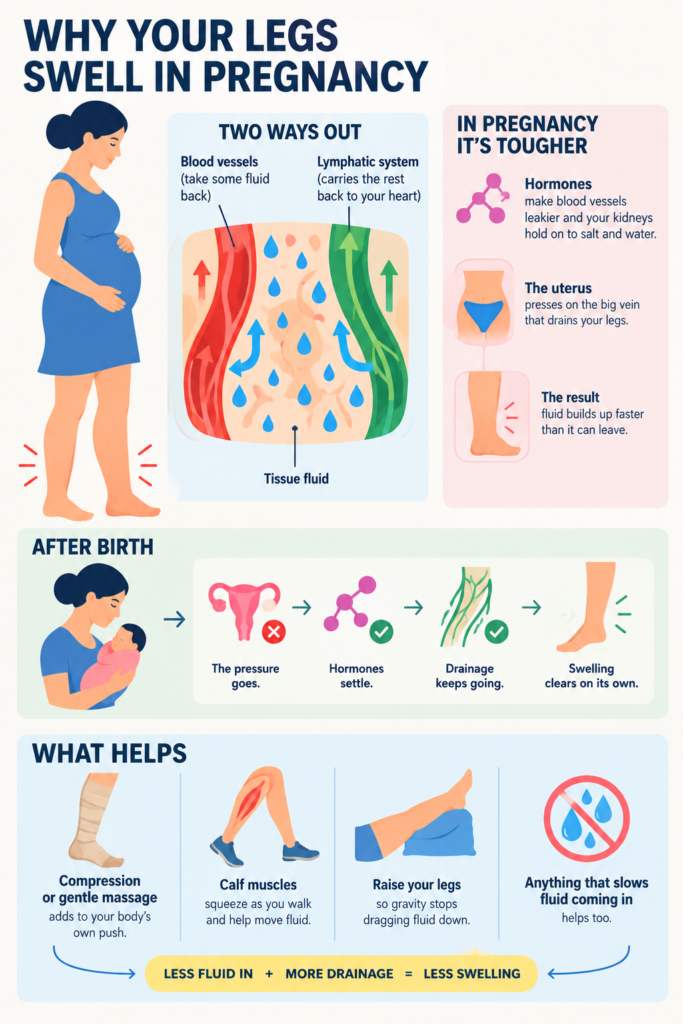
Your body has two ways of moving fluid out of your tissues. Blood vessels take some of it back, and the rest is picked up by the lymphatic system, a network of thin vessels that carries it back towards your heart.
A group of Brazilian researchers led by José Maria Pereira de Godoy studied leg swelling in pregnancy, and they described it as lymphatic overload (1).
In lymphedema the vessels are damaged. In pregnancy they are healthy, and they are being asked to carry more fluid than they can manage.
Hormones make your blood vessels leakier and push your kidneys to hold on to salt and water. On top of that, the weight of the uterus presses on the big vein that drains your legs, so fluid builds up faster than it can leave.
After birth the pressure from the uterus goes and the hormones start to settle, so less fluid comes in. The drainage keeps going, which is why the swelling eventually clears on its own.
The drainage also speeds up when there is more to drain, because the pressure of fluid in your tissues is itself what drives it into the lymph vessels, so the more fluid there is, the faster lymph flows (2).
That explains why the practical steps help. Gentle pressure from outside, like compression or slow massage strokes, adds to the push your body is already using, and so does pressure from inside, like your calf muscles squeezing as you walk.
Anything that slows the fluid coming in helps too, such as raising your legs so gravity stops dragging fluid down into your feet.
With that picture in your head, the daily routine makes a lot more sense.
Propping your feet on a stool while you sit on the sofa helps a little, but your feet are still below your heart, so gravity is still working against you.
For a real effect, lie back and raise your feet above heart level on a pile of pillows or up against a wall.
Aim for at least fifteen minutes at a time, several times a day. Feeding time can work well if you’re lying on your side or reclined with your legs up.
Compression is one of the few steps with any postpartum research behind it. A small 2017 study found that compression stockings reduced swelling in the first 24 hours after birth, although the authors said more research was needed.
Stockings only help if you can stand wearing them, and plenty of women find them hot or tight, especially in the first days. Ask your midwife or a pharmacist to measure you.
It’s easiest to put them on in the morning before the swelling builds, and you should take them off if they dig in or hurt.
Your calf muscles act as a pump, because every time they tighten they squeeze the veins and lymph vessels and push fluid upward. Short, slow walks around the house count, even in the first week.
If you’re recovering from a C-section or can’t walk much yet, ankle circles and pointing your toes up and down while you lie in bed do a similar job. Do twenty or so every hour you’re awake.
Drinking more water to get rid of water sounds backwards. The reasoning is that a dehydrated body holds on to fluid, and that makes sense, although I haven’t seen a trial that tests it for postpartum swelling.
Doctors do recommend it in practice, though. The mother whose story I’ll come back to later was told by her doctor to increase her fluids dramatically.
My honest advice is to let thirst guide you and to keep a glass of water nearby when you breastfeed, since feeding raises how much you need.
Salt makes your body hold water, and it hides in the foods that tend to show up in those first weeks, like takeaways and ready meals.
Eating fresher food where you can gives your kidneys an easier job, and a little salt is fine.
The last tool is the one you’ve probably seen all over social media, and there are real measurements on it that are worth knowing before you book anything.
Manual lymphatic drainage is a very light, slow, rhythmic massage that moves the skin in the direction of the lymph nodes. Online it is often sold as a way to flush out swelling in one session.
The Godoy group measured it directly (1). They took fifteen pregnant women and measured the volume of each leg by lowering it into water, once in the morning and again in the afternoon.
On days without treatment, each leg gained about 40 grams of fluid over the day. On days with one hour of drainage, each leg lost about 44 grams instead.
That difference was real and statistically significant. It is also small, roughly 84 grams on a leg weighing around 2,850 grams, which works out at about three percent.
So drainage stops the daily build-up and nudges it back a little. That is useful, and it is a long way from a dramatic flush.
Those women were still pregnant, which means the evidence for new mothers is borrowed. The closest link to the weeks after birth comes from a Spanish randomised trial of women in their second pregnancy who had swelling (3).
The treatment started at 25 weeks and carried on through the weeks after birth. The women who had lymphatic drainage reported less pain than those who had perineal massage.
That trial measured pain, so the honest summary is that drainage makes swollen legs feel better and shifts a modest amount of fluid. For a lot of tired women, feeling better is reason enough to try it.
If you’re interested in at-home options, you can also take a look at our guide to the best lymphatic drainage massage machines to learn more about the different types available.
If you want to try it, there are some firm rules. Get your obstetrician’s or midwife’s go-ahead first, and choose a therapist who has worked with pregnant and postpartum women.
The massage should stay off your breasts and your abdomen, which matters even more if you’ve had a C-section and have a healing wound.
It shouldn’t be used at all if you’ve been diagnosed with preeclampsia, or if any of the red flags from earlier apply to you.
You can also do a gentle version yourself. With a flat hand, stroke very lightly upward from ankle to knee and then from knee to hip, slowly, as if you’re only moving the skin.
Keep the touch light, because the lymph vessels sit just under the surface and heavy pressure squashes them.
Treat it as one small daily help alongside elevation and walking, because the biggest change is still ahead of you and it tends to arrive on its own schedule.
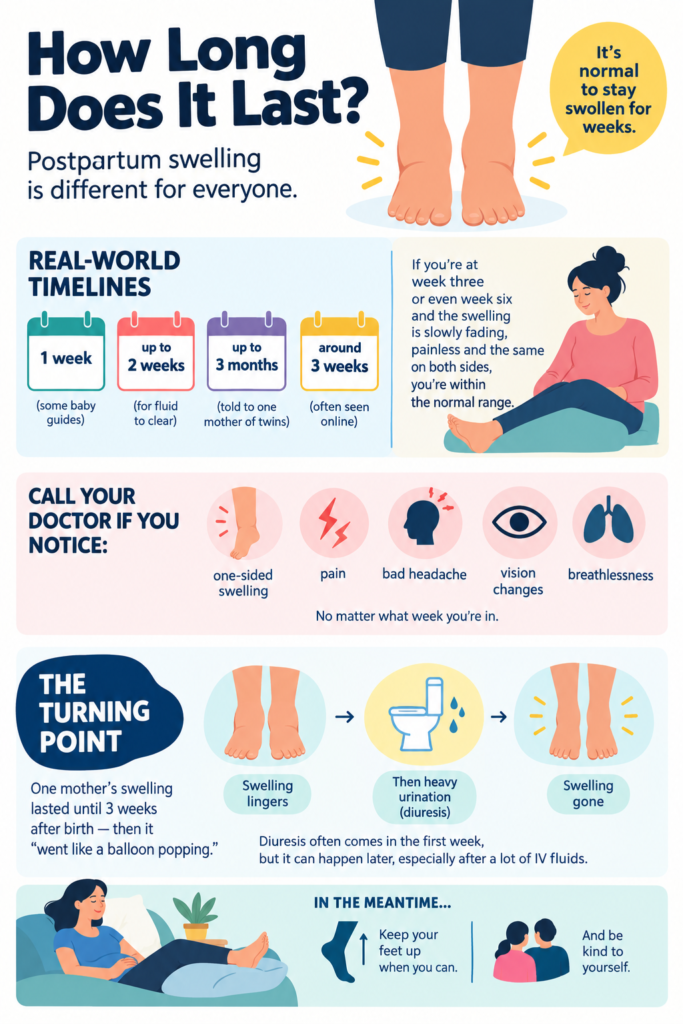
You’ll find very different answers about how long postpartum swelling should last. Some baby guides say about a week, with up to two weeks for the fluid to clear, while one mother of twins was told by her obstetrician that it could take up to three months.
Among women comparing notes online, about three weeks comes up again and again.
So if you’re at week three or even week six with swelling that is slowly fading, painless and the same on both sides, you’re well within what happens to real people.
The kind of swelling matters far more than the date on the calendar. Swelling on one side, pain, a bad headache, vision changes or breathlessness mean you call your doctor, whatever week you’re in.
Now for the end I promised you. One mother described swelling that started in mid-pregnancy and hung on until about three weeks after birth, and then it went “like a balloon popping”.
For two or three days she was weeing every half hour, and then the swelling was gone. The same thing happened in both of her pregnancies.
That burst of heavy urination has a name, diuresis, and it is your body releasing the surplus in one go once the hormones have settled far enough.
It often comes in the first week, but it can come later, especially after a lot of IV fluids.
So if you’ve done everything and your ankles still look the same, keep going. The fluid is clearing slowly in the background, and one week you’ll find yourself up at the toilet again and again, and then your feet will come back.
Until then, keep your feet up when you can and be kind to a body that has just done something enormous.
If you’re considering compression as part of your recovery, explore our top recommended Compression Garments for Leg Swelling to learn about different options and features.
Most postpartum swelling peaks during the first two to three days after delivery, then gradually improves over the following week. For many women, noticeable reduction happens within five to seven days, with full resolution typically occurring between one and six weeks postpartum.
The timeline varies based on how much IV fluid you received during labor, whether you had a vaginal or cesarean delivery, and how consistently you follow swelling-reduction strategies like hydration, elevation, and movement.
Diuretics are generally not recommended for normal postpartum edema because your body naturally flushes fluid through increased urination and sweating during the first week. Taking medication to speed this process can interfere with your body’s natural fluid balance and may reduce milk supply if you’re breastfeeding.
The exception is if you develop postpartum preeclampsia or another medical condition requiring diuretic therapy, which your healthcare provider would prescribe and monitor.
Hand swelling happens because of the same fluid redistribution that causes leg swelling, plus the extra IV fluids given during labor. Gravity works differently on your hands depending on how you position them throughout the day.
If you hold your baby with arms bent for extended periods, or sleep with your hands curled up near your chest, fluid pools in your fingers and hands.
Elevating your arms above your heart periodically, doing finger flexion exercises, and applying cold compresses can help reduce hand swelling faster.
One-sided leg swelling is not normal and requires immediate medical evaluation. While bilateral swelling in both legs is a common postpartum occurrence, swelling that affects only one leg, especially when accompanied by pain, redness, warmth, or tenderness in the calf, can show deep vein thrombosis.
This is a blood clot that requires urgent treatment.
If you notice one leg is significantly more swollen than the other, contact your healthcare provider right away.
Compression can help with perineal swelling by reducing tissue congestion and supporting blood flow in the area. Using firm, supportive underwear with double maternity pads creates gentle pressure that many women find helpful.
Some physiotherapists also recommend spending extended periods lying flat during the first forty-eight hours to take gravitational pressure off the pelvic floor.
Cold packs applied to the perineum for ten to fifteen minutes every one to two hours during the first few days provide extra swelling relief.
Breastfeeding can actually help reduce postpartum swelling faster. When you nurse, your body releases oxytocin, which helps your uterus contract back to its pre-pregnancy size and supports overall fluid balance.
However, breastfeeding does need you to stay well-hydrated, which some women mistakenly think might worsen swelling.
The opposite is true. Drinking plenty of water while breastfeeding supports both milk production and the natural diuresis that flushes postpartum fluid retention.
Avoid high-sodium foods like processed snacks, canned soups, fast food, deli meats, frozen meals, and restaurant food with heavy sauces. These cause your kidneys to retain water and worsen swelling.
Instead, focus on fresh, whole foods with high potassium content like bananas, sweet potatoes, avocados, and leafy greens.
Foods with natural water content like cucumbers, watermelon, and citrus fruits also support hydration without adding sodium.